Zero to Autonomous: How We Deploy a Fully Functional AI Agent in 7 Days
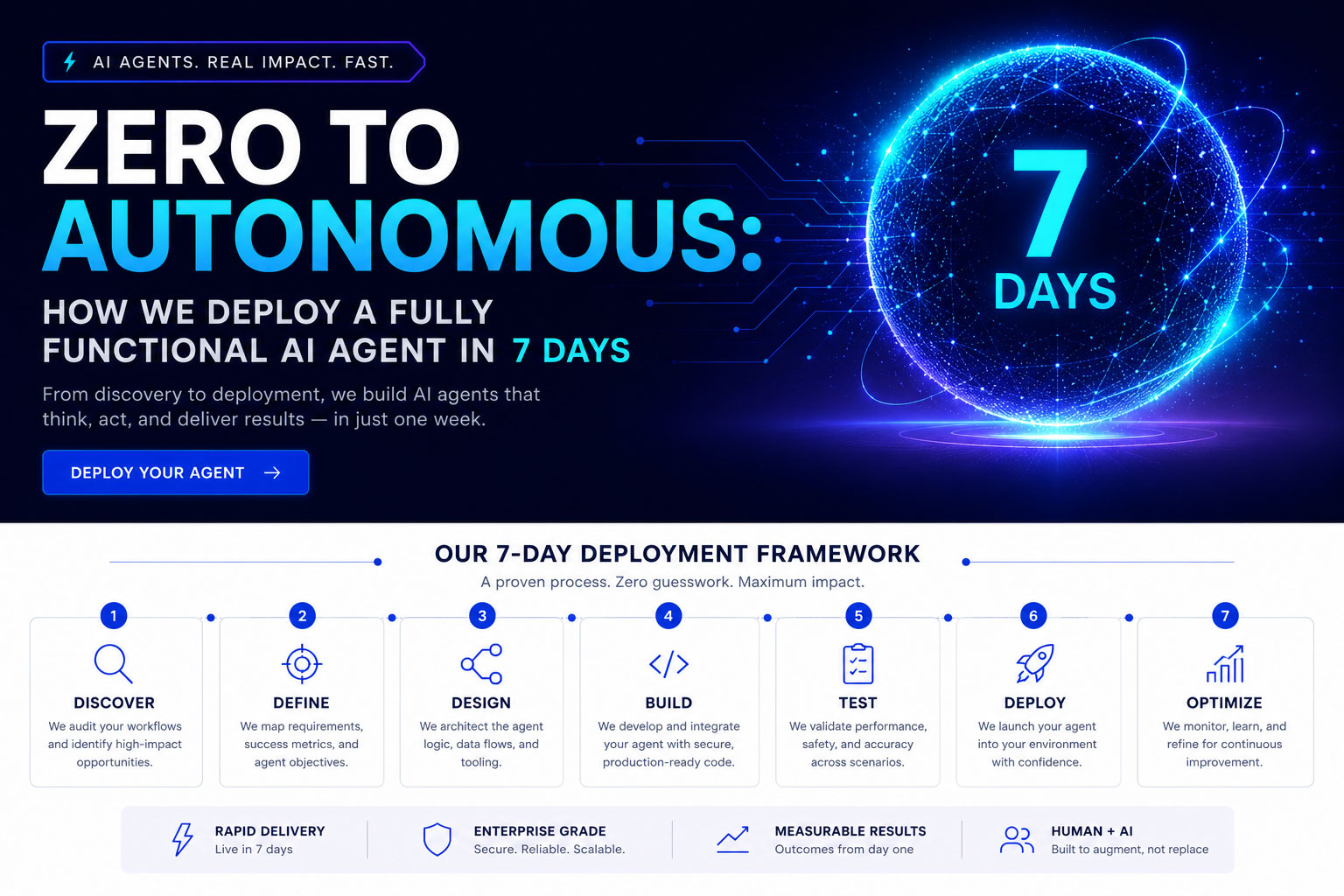
“Live in 7 days” is the kind of claim that should make you suspicious. Most software promises weeks and delivers months. Ninety percent of AI pilots never reach production at all. So when we say your first AI assistant is answering real work in a week, the fair response is: prove it.
This is us proving it. Below is the actual timeline — what happens each day, who does what, and why a week is enough. There’s no trick. The reason it’s fast is simple, and we’ll say it up front: we aren’t rebuilding your tech stack. We’re layering an intelligent action engine on top of it. Everything else follows from that.
Days 1–2 — Audit & Scope
The fastest way to fail is to point an agent at a vague, sprawling job. So we don’t start with the AI. We start with your workflow.
On day one we sit with the people who actually do the work and find the one process that’s high-friction and data-rich — the kind of task that eats hours, follows repeatable rules, and already leaves a clear paper trail. Infrastructure monitoring. Security digests. Customer onboarding. Claims intake. The specific job matters less than its shape: repetitive, legible, and painful enough that recovering those hours is obviously worth it.
Then we draw the boundaries. This is the part most “AI transformation” projects skip, and it’s why they stall. We define, in writing:
- What the agent owns — the exact steps it will handle end to end.
- What it never touches — the decisions that stay with a human.
- What “done” looks like — the measurable outcome we’ll hold it to.
By the end of day two you have a one-page scope. Not a roadmap. A contract. Narrow on purpose, because a narrow agent that works beats a broad one that doesn’t.
Days 3–4 — Configuration & Orchestration
Now we build — and “build” is the wrong word, because we’re mostly connecting.
Your business already runs on a stack: a CRM, a help desk, a scheduling tool, a database, an inbox. The agent’s job is to act inside that stack, not replace it. So days three and four are about orchestration — wiring the agent into the tools you already pay for, using battle-tested frameworks (think CrewAI, OpenClaw, and the model providers underneath) rather than anything bespoke and brittle.
Three things have to be true before we move on:
- Context. The agent knows your workflows, your data, and your voice — not a generic script.
- Access. It has the right API permissions to read what it needs and take the actions in scope, and nothing beyond them.
- Grounding. Its answers are tied to your real records, so it isn’t guessing.
This is the step that would take a normal team a quarter, because a normal team is trying to build a platform. We’re not. The platform exists. We’re teaching a capable assistant to use it the way your best people already do.
Days 5–6 — Testing & Guardrails
An agent that acts before it’s trustworthy is worse than no agent at all — one bad email to a customer costs more than a week of saved time. So before it touches anything live, it earns the right to.
We run the agent against real historical cases — the messy ones, the edge cases, the storm-surge days — and check its output against what actually happened. Where it’s right, we confirm. Where it’s wrong, we tune. Accuracy isn’t a vibe; it’s a number we can show you.
Then we set the guardrails that make “autonomous” safe:
- Human-in-the-loop checkpoints. Anything ambiguous or high-stakes escalates to a person for approval before the agent acts.
- An off-switch. You can pause or stop the agent instantly, with one click.
- Audit logs. Every action it takes is recorded and reviewable.
This is the difference between an AI assistant and an AI liability. The agent is capable of a lot — and it does exactly as much as you’ve decided it should, with a person watching the seams. Safety isn’t a feature we bolt on at the end. It’s the thing that lets us hand over the keys.
Day 7 — Go-Live
Day seven is quiet, which is the point.
The agent goes live on the workflow we scoped on day one. It starts handling real work — answering, triaging, drafting, scheduling — with its guardrails in place and its human checkpoints active. You’re not handed a science project and a login. You’re handed a working assistant, plus the dashboard to watch everything it does and the metrics that prove it’s paying off from the first week.
Then the real work begins: measuring. Hours saved. Resolution rate. Dollars recovered. Because a deployment that can’t show its value in numbers isn’t a deployment — it’s a demo that overstayed.
The takeaway
Seven days is possible for one reason worth repeating: you aren’t buying a rebuild. You’re buying an action engine that layers on top of the stack you already run. The audit is fast because your workflow already exists. The build is fast because your tools already exist. The trust is earned deliberately, because that’s the part you can’t rush — and it’s the part that turns a pilot into a permanent part of how your team works.
That’s the whole method. No black box, no “trust the process.” Just a scoped job, a careful integration, real testing, and a human in the loop — done in a week because there’s nothing to reinvent, only something to put to work.
If you’ve got a workflow that’s eating your team’s hours, we can tell you on a short call whether it’s a good first build — and if it is, what your seven days would look like.